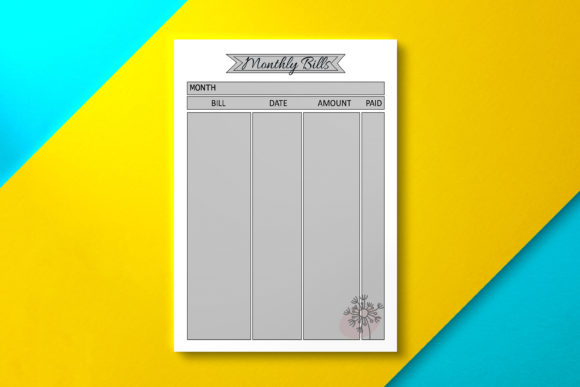
Evaluating Monthly Bill Tracker Gray for Personal and Commercial Use
Financial organization often fails not because of a lack of intent, but because of friction in the tracking process. When a budgeting tool is visually loud or overly complex, users tend to abandon it within weeks. The Monthly Bill Tracker Gray addresses this specific pain point by prioritizing visual neutrality and functional clarity over decorative excess. This product suite offers a comprehensive set of PDF files designed for both personal financial management and commercial publishing through platforms like Amazon KDP. By providing templates in Letter, Half Letter, A4, and A5 sizes, alongside a 50-page commercial-use manuscript, this resource targets two distinct audiences: individuals seeking a distraction-free expense log and digital publishers looking for ready-to-upload low-content book interiors.
Design Philosophy and Visual Utility
The defining characteristic of the Monthly Bill Tracker Gray is its monochromatic color scheme. In an era where many financial planners utilize high-saturation colors to denote categories or urgency, a gray-scale approach serves a practical psychological function. Gray is non-stimulating and recedes visually, allowing the data itself to take precedence. For users who print their trackers at home, this design choice significantly reduces ink consumption compared to full-color alternatives. More importantly, the neutral tone ensures that handwritten annotations in various pen colors remain legible and aesthetically pleasing without clashing with pre-printed elements.
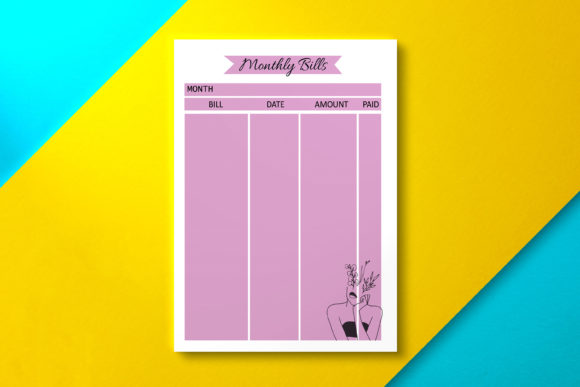
The layout typically follows a grid-based structure optimized for quick data entry. Rather than forcing users into rigid categorization systems, these trackers generally provide open columns for date, payee, category, amount due, amount paid, and notes. This flexibility is crucial for real-world application where billing cycles vary and unexpected expenses arise. The typography is clean and sans-serif, ensuring readability even when printed at smaller sizes like A5 or Half Letter. This attention to typographic hierarchy prevents the page from feeling cluttered, a common issue in dense financial spreadsheets.
Format Versatility Across Standards
One of the strongest practical assets of this product line is the inclusion of four distinct international paper standards. Each size serves a different operational context:
- Letter Size (8.5 x 11 inches): The standard for North American home filing and office use. This size offers maximum writing space and is ideal for users who track numerous line items per month or prefer to keep records in standard three-ring binders.
- Half Letter (5.5 x 8.5 inches): Increasingly popular in the planner community, this size fits compact disc-bound or ring-bound systems. It is portable enough for daily carry but retains sufficient width for comfortable handwriting.
- A4 (210 x 297 mm): The international standard outside North America. Essential for users in Europe, Asia, and Oceania who require compatibility with local filing supplies and printers.
- A5 (148 x 210 mm): The most common size for personal journals and pocket planners. This format encourages concise tracking and integrates seamlessly with existing A5 notebook ecosystems.
Having all four formats available eliminates the need for manual resizing, which often distorts margins and line weights. The files are pre-formatted with appropriate bleed and safety zones, ensuring that whether you are printing a single sheet for personal use or binding a book for sale, the alignment remains precise.
Commercial Viability for KDP Publishers
For entrepreneurs and creators in the low-content publishing space, the 50 pages Monthly Bill Letter Ready Commercial Use file represents a significant time-saving asset. Creating a 50-page interior manually involves repetitive formatting, margin calculations, and consistency checks that can consume hours of production time. This pre-assembled manuscript allows publishers to bypass the technical setup phase and focus on cover design, keyword research, and marketing strategy.
However, experienced publishers should approach this resource with strategic awareness. Because "ready commercial use" templates are accessible to multiple buyers, the risk of market saturation exists. To maintain competitiveness, this tracker should be viewed as a foundational base rather than a final product. Successful KDP sellers often differentiate their offerings by bundling this gray tracker with complementary content, such as annual budget summaries, debt payoff calculators, or savings challenge logs. Alternatively, using the gray aesthetic as a consistent brand element across a series of financial journals can help build recognition despite the shared interior template.
The commercial license typically permits unlimited physical book sales but prohibits reselling the digital PDF files themselves. Publishers must verify the specific licensing terms included with their purchase to ensure compliance with platform policies. From a quality assurance perspective, the 50-page file is structured to meet Amazon’s printing specifications, including proper gutter margins to prevent text from disappearing into the binding. This technical reliability reduces the likelihood of rejected uploads or poor customer reviews related to formatting errors.
Practical Application for Diverse Users
Beyond publishing, the individual 1-page trackers serve immediate needs for various professional and personal demographics. Freelancers and small business owners often require separate tracking for business versus personal expenses to simplify tax preparation. The clean, unbranded nature of the Monthly Bill Tracker Gray makes it suitable for client-facing financial coaching or as a complimentary resource for blog readers without appearing promotional. Educators teaching financial literacy can distribute these sheets as worksheets, benefiting from the ink-friendly grayscale design and clear, uncluttered layout that doesn’t overwhelm students new to budgeting.
For serious hobbyists managing project budgets—such as event planning, home renovation, or craft businesses—the tracker provides a dedicated space to monitor costs against estimates without the overhead of accounting software. The analog nature of the tracker encourages mindfulness; writing down expenses has been shown to increase retention and awareness of spending habits more effectively than automated app notifications. The gray colorway supports this mindful practice by reducing visual noise and keeping the focus on numerical accuracy.
Assessing Quality and Limitations
When evaluating any digital template, file integrity and usability are paramount. These PDFs are vector-based or high-resolution raster files, meaning lines remain crisp at any zoom level or print size. The contrast ratio between the gray lines and white background is calibrated to be visible yet subtle, avoiding the harshness of pure black grids that can make handwriting look messy. Margins account for standard home printer limitations as well as professional binding requirements, demonstrating an understanding of end-user hardware constraints.
Despite these strengths, potential users should recognize inherent limitations. As a static PDF, the Monthly Bill Tracker Gray lacks the automated calculations, recurring transaction features, and data visualization of digital apps. It requires manual discipline and regular review to be effective. Users accustomed to instant feedback loops may find the analog adjustment period challenging. Additionally, while the gray aesthetic is versatile, some users may find it too austere and prefer color-coded systems for faster visual scanning. The product excels in minimalism but does not attempt to serve those who rely on chromatic organization methods.
Furthermore, commercial users should conduct their own niche research before uploading. While the template is professionally executed, success on KDP depends heavily on external factors like cover design quality, keyword targeting, and seasonal demand. The tracker solves the production bottleneck but does not guarantee sales volume. Treating it as one component of a broader publishing strategy yields better long-term results than relying on it as a standalone income stream.
Making an Informed Decision
The Monthly Bill Tracker Gray occupies a useful intersection between personal utility and commercial infrastructure. For individuals, it offers a refined, economical, and flexible alternative to mass-market planners that often prioritize aesthetics over function. Its multi-format availability respects diverse geographical and organizational preferences, making it a genuinely practical tool rather than a generic download. For publishers and creators, it provides a reliable, specification-compliant foundation that accelerates time-to-market while maintaining professional presentation standards.
Ultimately, the value of this resource lies in its restraint. By stripping away unnecessary decoration and focusing on universal sizing and clean typography, it serves as a canvas for financial clarity rather than a prescriptive system. Whether you are organizing your own household expenses, creating resources for clients, or building a portfolio of low-content books, the effectiveness of this tracker depends less on the file itself and more on how thoughtfully you integrate it into your existing workflows and strategies. It is a tool defined not by what it adds, but by what it removes, creating space for the user’s own data and decisions to take center stage.