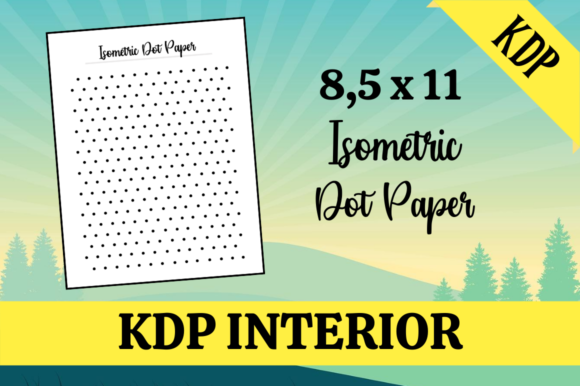
Isometric Dot Paper KDP Interior: A Technical Guide for Low-Content Publishing
The landscape of self-publishing has shifted significantly toward functional utility, where the value of a book lies not in its prose but in its ability to facilitate specific tasks. Among the various niche interiors available to creators, the Isometric Dot Paper KDP Interior stands out as a specialized tool that bridges the gap between artistic expression and technical precision. Unlike standard graph paper or lined notebooks, isometric grids serve a distinct cognitive and practical purpose, making them an essential asset for low-content business models targeting engineers, artists, educators, and designers. Understanding the technical specifications and market applications of this interior is crucial for publishers aiming to provide genuine value rather than saturated generic content.
The Functional Distinction of Isometric Grids
To effectively market or utilize an isometric notebook, one must first understand how it differs fundamentally from other grid types. Standard graph paper uses perpendicular lines to create squares, representing a two-dimensional Cartesian coordinate system. In contrast, isometric dot paper features dots arranged in equilateral triangles, creating a three-axis grid where each axis is separated by 120 degrees. This geometric arrangement allows users to draw three-dimensional objects without the distortion inherent in perspective drawing.
For professionals and students, this distinction is vital. The isometric projection maintains true scale along all three axes, meaning measurements remain consistent regardless of depth. This makes the Isometric Dot Paper KDP Interior superior for technical sketching, architectural ideation, and mechanical design where proportional accuracy is required alongside spatial visualization. When selecting or creating this interior, the spacing between dots is a critical variable; typically, a 5mm or 0.2-inch spacing offers the optimal balance between detail and usability for the standard 8.5 x 11 trim size.
Technical Specifications for KDP Compliance
Success in Amazon KDP publishing relies heavily on adherence to strict printing guidelines. A professionally formatted Isometric Dot Paper KDP Interior eliminates common rejection errors and ensures a high-quality user experience. For the 8.5 x 11 inch trim size with no bleed, the margin requirements are non-negotiable. While KDP allows for smaller margins on books with lower page counts, a 120-page book requires careful attention to the gutter (inside margin) to prevent the grid from disappearing into the binding.
A safe and professional configuration for this specific interior includes:
- Trim Size: 8.5" x 11" (US Letter), the industry standard for technical and academic notebooks.
- Bleed Settings: No Bleed. All grid elements must remain within the safe zone, typically maintaining at least a 0.375" margin on the outside edges and a 0.5" to 0.625" gutter depending on final page count.
- Page Count: 120 pages. This thickness provides substantial utility without becoming unwieldy or expensive to print, striking an ideal price-to-value ratio.
- File Format: Print-ready PDF. Vector-based PDFs are preferred over raster images to ensure crisp dot reproduction at any zoom level during the proofing process.
Furthermore, offering two different variants of PDF files adds significant value to the product. One variant might feature a darker dot opacity for high-contrast visibility, suitable for pencil work and scanning, while the second variant could utilize a lighter, subtle grey tone that recedes visually, allowing ink drawings and colored markers to take precedence. This duality addresses the varying preferences of the target audience and reduces return rates due to unmet expectations regarding grid visibility.
Diverse Applications Across Professional Fields
The versatility of isometric paper extends far beyond art classrooms. Identifying these specific use cases helps in crafting metadata, descriptions, and categories that align with search intent. Engineers and industrial designers frequently use isometric sketches for rapid prototyping and communicating assembly concepts to teams. Because isometric drawings do not require vanishing points, they can be sketched quickly during meetings or site visits while retaining technical validity.
In the realm of education, this paper serves as a tactile learning aid for STEM subjects. Teachers utilize it to help students visualize molecular structures in chemistry, crystal lattices in geology, or geometric transformations in mathematics. For hobbyists and gamers, isometric grids are indispensable for designing game maps, dungeon layouts for tabletop RPGs, and pixel art patterns. By positioning the Isometric Dot Paper KDP Interior as a multi-disciplinary tool, publishers can tap into several distinct keyword niches simultaneously, from "engineering sketchbook" to "RPG map making pad."
Design Considerations for User Experience
Creating a functional interior goes beyond simply tiling a pattern across 120 pages. Thoughtful design enhances the perceived quality of the book. Since this is a no-bleed interior, the alignment of the grid relative to the page edge must be mathematically precise. Misaligned grids that drift toward the gutter or vary from page to page are a hallmark of low-quality publications and result in negative reviews.
Additionally, consider the inclusion of functional front matter. Even in a low-content book, a title page, a copyright page, and perhaps a brief guide on "How to Use Isometric Paper" can elevate the product from a simple stack of paper to a comprehensive resource. Some successful interiors also include a reference chart on the inside cover or first page showing basic isometric shapes (cubes, cylinders, pyramids) to assist beginners. These small additions increase dwell time and customer satisfaction without significantly increasing production complexity.
Optimizing for Print Quality and Paper Stock
Amazon KDP uses standard white paper (typically 55# or 90 GSM) for black and white interiors. Publishers must account for the characteristics of this stock when designing isometric grids. Heavy lines or solid black dots can sometimes cause show-through or bleed-through on this paper weight, especially if the end-user employs markers or fountain pens. Testing the Isometric Dot Paper KDP Interior involves ordering physical proofs to evaluate dot density.
Ideally, dots should be small and sharp rather than large and bold. A dot diameter of roughly 0.5pt to 0.75pt is usually sufficient for visibility without overwhelming the page. Using a rich black (CMYK blend) versus standard 100% K black can sometimes yield crisper results on digital presses, though for simple line art, standard black is generally safer to avoid registration issues. Ensuring the file is tested specifically for the 8.5 x 11 no-bleed configuration prevents white borders from appearing unevenly, which is a common aesthetic flaw in amateur isometric notebooks.
Strategic Positioning in the Low-Content Market
While "low content" implies minimal text, successful products in this category are defined by high intentionality. The market is saturated with generic notebooks, but specialized tools like isometric paper face less competition because they require specific knowledge to produce correctly. When listing an Isometric Dot Paper KDP Interior, the description should focus on the problem-solving aspect of the grid. Rather than merely stating "120 pages of dots," effective copy explains how the 120-degree angle facilitates 3D visualization or how the no-bleed format maximizes usable drawing space.
Creators should also leverage the dual-variant strategy in their marketing. Highlighting that the purchase includes access to both high-contrast and low-contrast versions (if sold as a bundle or digital download accompanying the physical book) differentiates the offer. For those using the interior strictly for KDP physical sales, ensuring the chosen variant matches the primary audience's needs is key; engineering audiences often prefer higher contrast for blueprint-style reproducibility, while artists may prefer subtlety.
Maintaining Relevance Through Quality Assurance
The longevity of a KDP business depends on maintaining high standards. Regularly updating interiors to match current KDP template specifications is necessary, as Amazon occasionally adjusts margin tolerances or printable areas. A file that was compliant two years ago may trigger warnings today. Utilizing the latest PDF/X-1a standards ensures color consistency and font embedding, preventing the grid from shifting during the printing process.
Furthermore, gathering feedback from actual users can inform future iterations. If customers consistently mention that the dots are too faint or the margins are too tight, these data points become the roadmap for version 2.0. In the niche of technical stationery, precision is the product. An Isometric Dot Paper KDP Interior that is rigorously tested, properly formatted for 8.5 x 11 no bleed, and tailored to the specific needs of spatial thinkers will always outperform a hastily assembled alternative. By treating the interior as a precision instrument rather than a commodity, publishers build authority and trust within specialized communities, ensuring sustainable performance in the competitive self-publishing ecosystem.