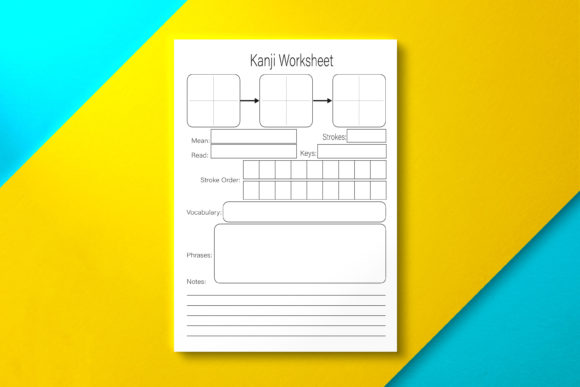
Mastering Kanji Practice: A Complete Guide to Black Grid Worksheet Templates for KDP and Personal Use
Learning Japanese is a journey that requires dedication, consistency, and the right tools. Among the three writing systems used in Japan, Kanji presents the most significant hurdle for students. Unlike Hiragana and Katakana, which are phonetic syllabaries, Kanji are logographic characters adopted from Chinese, each carrying specific meanings and multiple pronunciations. To master these complex characters, rote memorization is rarely enough; physical writing practice is essential for building muscle memory and understanding stroke order. This is where high-quality Kanji Worksheet Paper becomes an indispensable resource.
For educators, self-publishers, and independent learners, having access to professional-grade templates is a game-changer. Specifically, Kanji Worksheet Paper Black grids provide the necessary visual structure for practicing character balance and proportion. Whether you are creating a commercial product for Amazon KDP or printing study sheets for personal use, understanding the nuances of file sizes, grid styles, and commercial licensing is vital. This guide explores the practical applications of these worksheets, the importance of standard paper sizes like Letter, A4, and 6x9, and how to leverage ready-made files for educational and business success.
The Pedagogy of Genkou Youshi and Black Grids
To understand why specific worksheet templates matter, one must first understand the traditional method of Japanese writing practice. The gold standard for Kanji practice is Genkou Youshi (manuscript paper). While traditional Genkou Youshi often features vertical columns, modern Kanji worksheets frequently utilize square grids designed specifically for isolated character practice.
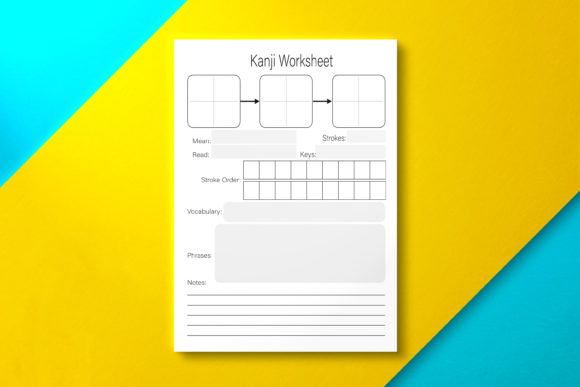
Kanji Worksheet Paper Black refers to templates where the grid lines are solid black rather than gray or dotted. While lighter lines are sometimes preferred for tracing, solid black grids serve a distinct pedagogical purpose:
- Boundary Definition: High-contrast black lines create a definitive border, helping students understand the spatial limits of a character.
- Visual Anchoring: The strong lines act as a reference point for the center and quadrants of the character, ensuring proper balance.
- Print Clarity: For KDP publishers, black lines reproduce more consistently across different printing presses compared to light gray lines, which can sometimes appear muddy or disappear entirely on lower-opacity paper.
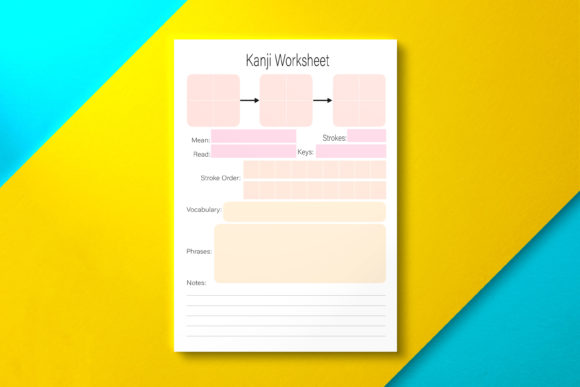
These worksheets typically include crosshairs or diagonal guides within the main square. These internal guides are not merely decorative; they teach the learner to center the character and maintain symmetry, which is crucial for legible handwriting.
Navigating Paper Sizes for Global Audiences
One of the most critical aspects of creating or purchasing Kanji worksheet files is selecting the correct dimensions. The market for Japanese learning materials is global, meaning your audience may be located in North America, Europe, Asia, or elsewhere. Providing multiple size variations ensures accessibility and usability for everyone.
Letter Size (8.5 x 11 inches)
The 1-page Kanji Worksheet Letter and 110 pages Kanji Worksheet Letter formats cater primarily to the United States and Canadian markets. This is the standard size for home printers and school binders in North America. For KDP authors targeting English-speaking learners of Japanese, Letter size is often the safest default choice. It offers ample space for large practice grids, making it ideal for beginners who need room to form complex characters without feeling cramped.
A4 Size (210 x 297 mm)
The 1-page Kanji Worksheet A4 is the international standard used in Japan, Europe, Australia, and most of Asia. If your target audience includes learners currently residing in Japan or studying in international schools, A4 is non-negotiable. Printing an A4 PDF on Letter paper (or vice versa) results in awkward margins and scaling issues that can distort the aspect ratio of the practice grids, potentially hindering proper stroke formation.
Half Letter and A5 (Compact Learning)
The 1-page Kanji Worksheet A5 and Half Letter sizes represent a growing trend in portable education. At roughly half the size of their full-sized counterparts, these formats are perfect for commuters, travelers, and students who prefer working in smaller notebooks. From a publishing perspective, A5 and Half Letter books feel more like personal journals than textbooks, which can reduce the psychological friction associated with daily study. They are excellent for "daily drill" style books where the user only needs to practice a few characters per session.
6x9 Inches (The Trade Paperback Standard)
The 1-page Kanji Worksheet 6x9 in and 110 pages Kanji Worksheet 6x9 in formats occupy a sweet spot in the self-publishing industry. This trim size is widely recognized as the standard trade paperback dimension. It is large enough to accommodate functional writing grids but compact enough to be cost-effective to print and ship. For KDP creators, 6x9 often yields better royalty margins than larger formats while still providing a professional, bookstore-quality feel.
Commercial Use and KDP Readiness
For entrepreneurs and content creators, the phrase Ready Commercial Use carries significant weight. Creating high-quality interior templates from scratch requires graphic design skills, knowledge of bleed and margin specifications, and hours of formatting. Acquiring pre-made, Ready KDP upload files streamlines this process dramatically.
However, users must understand what makes a file truly "KDP Ready":
- Correct Bleed Settings: If the grid extends to the edge of the page, the file must include bleed (usually 0.125 inches on the outer edges). Files lacking proper bleed will be rejected or printed with unwanted white borders.
- Safe Margins: Kanji worksheets require generous inner margins (gutter) to account for binding. A grid placed too close to the spine makes the book unusable for writing practice.
- Resolution: Print-ready PDFs should be generated at 300 DPI minimum to ensure crisp, sharp lines. Pixelated grids look unprofessional and frustrate learners.
- Licensing Terms: Always verify that the "Ready Commercial Use" designation allows for unlimited sales. Some licenses restrict the number of copies or require attribution.
The availability of both single-page templates and complete 110-page manuscripts allows creators to mix and match. You might use a single-page template to create custom flashcards or handouts, while utilizing the 110-page manuscript as the foundation for a comprehensive workbook.
Practical Applications Beyond Self-Publishing
While KDP publishing is a primary driver for these assets, the utility of Kanji Worksheet Paper extends far beyond commercial book creation. Understanding these broader applications helps maximize the value of your purchase or design efforts.
For Educators and Tutors
Japanese language teachers often need supplementary materials that textbooks do not provide. Having a library of sized-specific templates allows tutors to create customized homework packets. For example, a tutor might assign A5 worksheets to younger students with smaller hands, while giving adult learners Letter-sized sheets for detailed stroke analysis. The ability to print single pages on demand means educators never have to commit to printing hundreds of copies of a static workbook.
For Digital Note-Takers
In the modern era, many learners use tablets like the iPad with Apple Pencil or Android equivalents. PDF Kanji worksheets are highly sought after as digital planner inserts. Users import the 1-page Kanji Worksheet A4 or 6x9 files into apps like GoodNotes or Notability to practice digitally. This eliminates paper waste and allows for infinite repetition. Creators who optimize their PDFs for digital use (e.g., by including hyperlinks or ensuring layers are flattened correctly) tap into a rapidly expanding niche.
For Homeschooling Parents
Families raising bilingual children or homeschooling Japanese curriculum often struggle to find structured writing practice that fits their specific pacing. Commercial workbooks move too fast or too slow. With editable or printable worksheet templates, parents can curate a bespoke learning experience, focusing on specific JLPT levels or Joyo Kanji lists at their child's unique pace.
Common Misunderstandings About Kanji Worksheets
Despite their simplicity, there are misconceptions about using these tools effectively. Addressing these ensures better outcomes for both creators and learners.
Misconception: Any square grid works for Kanji.
Reality: Proportion matters. Kanji are designed to fit within a specific aspect ratio. Using rectangular or improperly scaled grids can teach bad habits regarding character shape and balance. Always use templates specifically designed for Kanji rather than generic graph paper.
Misconception: More pages equal better value.
Reality: A 110-page book is useful, but quality trumps quantity. A well-structured 50-page book with clear instructions, varied grid sizes, and proper spacing is often more effective than a bloated 150-page book with poor margins. When evaluating Ready KDP upload files, inspect the interior layout critically before publishing.
Misconception: Black grids are only for advanced students.
Reality: While some beginners prefer gray guidelines, many find black grids superior for establishing confidence. The clear boundaries reduce ambiguity. It is often beneficial to offer both styles or explain the intended use case clearly in your product description.
Building a Sustainable Practice Habit
Ultimately, the goal of any Kanji Worksheet Paper is to facilitate consistent practice. Whether you are selling these resources or using them yourself, remember that the tool serves the habit. The variety of sizes—from the expansive Letter format to the pocket-friendly A5—acknowledges that learning happens in different contexts. Some days require deep focus at a desk; others call for quick review during a lunch break.
By leveraging professional, commercially-ready templates, creators can focus on marketing and curriculum development rather than formatting mechanics. Learners, in turn, benefit from higher-quality, more accessible materials that respect the traditions of Japanese calligraphy while embracing modern publishing standards. In the world of language learning, clarity leads to competence, and the right worksheet is the first step toward mastering the beautiful complexity of Kanji.