Free Lined Journal Cover - KDP: Streamlining Your Low-Content Publishing Workflow
For self-publishers and digital product creators, the bottleneck in low-content book creation is rarely the interior; it is almost always the cover. The Free Lined Journal Cover - KDP resource addresses this specific friction point by providing a pre-formatted, print-ready asset that integrates directly into Amazon KDP workflows. This tool is not merely a graphic file; it is a production accelerator designed for entrepreneurs, educators, and freelancers who need to move from concept to live listing without spending hours configuring bleed settings or spine calculations.
In the broader context of a publishing business, this cover template serves as a foundational layer. It allows creators to bypass the technical setup phase of cover design and focus immediately on branding and market positioning. Whether you are launching a new line of productivity journals, creating supplementary materials for a course, or testing a new niche keyword strategy, having a standardized 8.5″ x 11″ cover with correct bleed specifications ensures that your output remains consistent and professional across multiple titles.
Technical Specifications and Platform Compatibility
Understanding the technical parameters of the Free Lined Journal Cover - KDP is essential for avoiding rejection during the upload process. Amazon’s automated review system is stringent regarding trim size and bleed. This resource is engineered specifically to meet those requirements, reducing the risk of error margins that often plague manual designs.
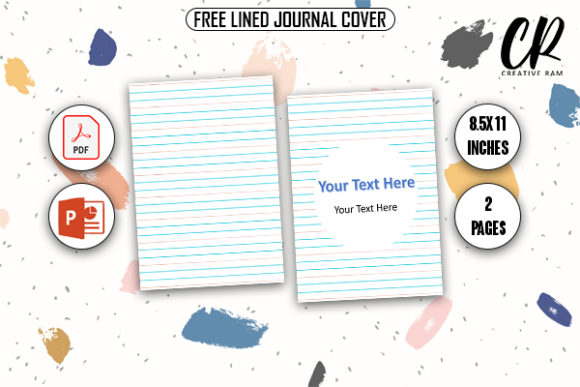
- Dimensions: 8.5″ x 11″ Inches (Standard US Letter). This is the most versatile size for lined journals, suitable for academic, professional, and personal use cases.
- Bleed Configuration: Includes proper bleed allowance. This ensures that when the physical book is trimmed during manufacturing, no white edges appear where color or design elements extend to the page boundary.
- Page Count Setup: Configured for 2 pages (Front and Back cover spread). Note that spine width must be adjusted based on your final interior page count if using the editable source files.
- File Formats: Delivered in PNG, PDF, and PPTX. Each format serves a distinct function in the production pipeline.
The inclusion of multiple file types is a critical workflow feature. While the Print Ready PDF is the final deliverable for KDP, the PNG serves as a high-resolution mockup for marketing materials, and the PPTX (PowerPoint) file acts as an accessible editing environment for users who do not have Adobe InDesign or Photoshop. This multi-format approach democratizes access, allowing marketers and small business owners to customize assets using software they already own.
Integrating the Cover Into Pre-Launch Planning
Effective use of this resource begins before you write a single word of description or select keywords. During the planning phase, the Free Lined Journal Cover - KDP functions as a visual prototype. For entrepreneurs and bloggers validating a new niche, seeing a tangible cover helps assess market fit more accurately than abstract ideas.
Consider a scenario where you are researching "gratitude journaling for nurses." Instead of guessing what aesthetic resonates, you can rapidly apply different color schemes and typography to the provided PPTX template. This rapid prototyping allows you to create test listings or social media polls to gauge audience interest. Because the template handles the structural dimensions, your time is spent entirely on creative direction and market research rather than ruler measurements.
This stage also involves compatibility checks with your interior files. Since the cover is set to 8.5″ x 11″ with bleed, your interior manuscript must match these exact dimensions. Using this cover template as your starting anchor prevents the common mistake of designing an interior in A4 size only to realize later that it does not align with standard US trade journal covers. Establishing this dimensional standard early streamlines the entire project architecture.
Execution: Customization and Quality Control
During the active creation phase, the workflow shifts from planning to execution. The Free Lined Journal Cover - KDP provides a safe container for customization. When working within the PowerPoint or PDF source files, maintain a disciplined approach to layers and safe zones.
Working With Source Files
If you are utilizing the PPTX file for customization, treat the slide master as your guide. Keep critical text and logos at least 0.375 inches away from the trim edge to account for mechanical variance during printing. The template’s bleed area is there to protect your design, but content safety is your responsibility. For users exporting from Canva or similar tools into the provided PDF structure, ensure you are placing your flattened artwork precisely over the bleed guides.
Quality Assurance Checklist
Before uploading to KDP, run through a verification process specific to this asset:
- Resolution Check: Verify that any images inserted into the PNG or PPTX base are at least 300 DPI. Upscaling low-resolution web graphics will result in pixelation that KDP may flag or customers will return.
- Color Profile: Confirm your export settings. KDP accepts both RGB and CMYK for paperback covers, but RGB often yields brighter results for digital previews while CMYK offers more predictable print outcomes. Test both if color accuracy is paramount to your brand.
- Spine Width Adjustment: If your journal exceeds 100 pages, the default 2-page spread may require spine modification. Use the KDP Cover Calculator to determine exact spine width and adjust the PPTX template accordingly before finalizing your PDF.
- Text Legibility: Ensure title and author name contrast sufficiently against the background. Accessibility is not just a compliance issue; it directly impacts thumbnail click-through rates on Amazon.
Post-Publication Utility and Asset Repurposing
The value of the Free Lined Journal Cover - KDP extends beyond the initial upload. Once your book is live, the associated PNG and PDF files become core marketing assets. Consistency in branding builds trust, and reusing the exact cover geometry across platforms reinforces product recognition.
For educators and coaches, the high-quality PNG can be embedded directly into course modules, lesson plans, or student handouts. If you are selling a bundle that includes a digital download alongside the physical KDP book, providing the matching digital cover creates a cohesive user experience. Marketers can use the source files to quickly generate seasonal variations—such as adding a "Back to School" badge or a "New Year Edition" ribbon—without redesigning the entire layout. This agility allows small business owners to keep listings fresh and relevant with minimal effort.
Furthermore, maintaining an organized library of these customized covers aids in long-term portfolio management. By keeping the master PPTX files labeled by niche and version, you create a scalable system. When you decide to expand a successful journal line into related topics, you can duplicate the master file, swap the subtitle and accent colors, and have a new product ready for upload in minutes. This systematic reuse is what separates hobbyists from sustainable publishing businesses.
Workflow Efficiency and Strategic Considerations
Adopting the Free Lined Journal Cover - KDP into your routine is ultimately about efficiency. However, efficiency should not come at the cost of distinctiveness. While the template solves technical hurdles, your competitive advantage lies in how you adapt it. Avoid using the default configuration without modification. Amazon’s marketplace rewards uniqueness, and customers can identify generic templates.
Use this resource as a baseline, not a final destination. Combine it with original photography, custom illustrations, or proprietary branding elements to create something that belongs to your specific ecosystem. The goal is to leverage the free technical foundation so you can invest more resources into the creative and strategic aspects that actually drive sales.
Finally, consider the legal and licensing aspects of free resources. Always verify the usage rights associated with the download. Ensure the license permits commercial use on KDP and check if attribution is required. Respecting intellectual property protects your business from future takedowns and maintains your professional integrity. When used correctly and ethically, this cover template is a powerful lever for scaling your low-content publishing operations while maintaining high standards of quality and consistency.